
Body Age: a number you can verify yourself
A stress score tells you about today. Body Age tells you where you're heading over the long run. Here's how the number is built, why its zero point matters, and why every row in the bill adds up.
Beyond stress, you need a long-term answer
Stress tells you about today — how last night's sleep went, whether your HRV recovered, whether you should slow down. All of that lives on a scale of days.
But over time, people ask a slower question: over the past year or two, am I heading in a good direction or a bad one? The bathroom scale can't answer it. A checkup happens once a year, and the three hundred days in between are blank.
Body Age tries to answer that one question. It ignores any single day's noise and instead reads the last 28 days of sleep, activity and resting heart rate, then gives you one conclusion: where you stand among people your age.
What it is, and what it isn't
Let's get the boundaries straight first:
It is not a medical exam, and never replaces a doctor.
It is not cellular or biological age — a watch can't measure that.
It is not a lifespan prediction.
It is a position. Based on how you sleep, how you move, and how hard your heart works, your level of health risk sits a few years above or below the average for your age. Do better than your peers and the number drops; do worse and it rises.

A concrete example: 39.2 years old, 5.8 years younger than peers — that's the conclusion body age gives you. Scroll down, and you'll see how it's broken down line by line.
How a number becomes years
There's no secret black box of weights here. The risk level of each thing — steps, sleep, heart rate — is backed by published cohort studies. Walking more carries less risk; sleeping too little carries more.
Then we do one key thing: translate risk into years. There's an empirical rule of thumb — an adult's mortality risk roughly doubles every 8 years. So "this raises your risk by 10% relative to peers" becomes "about +1 year".
This approach has a name: risk-equivalent age. We chose it over the more common alternative (back-computing a "fitness age" from VO2max) for one practical reason: it's stable. The same measurement wobble can make fitness age swing by 16 years overnight; risk-equivalent age moves only 2–3. We'd rather give a number that's mild and explainable than one that jumps around and looks scary.
Where you put zero decides the whole bill
This is the least intuitive, and most important, step.
Every "+" and "−" in a bill is relative to some reference line. Where that line sits decides what the bill looks like:
Put it at "healthy recommendations" (150 minutes of exercise a week, 7,842 steps a day…) and most people fall short — the bill comes out all "+", like being graded.
Put it at "average for your age" and roughly half sit above, half below — a mix of plus and minus, like measuring a position.
Same person, same data, just a different reference line — and the result moves from +2.9 years to +0.3. In the sentence "your body is like someone X years old", that "X" can only be on the scale of your peers. So recommendations never enter the score; they only appear in advice — "60 minutes short of 150 this week".
The bill has to add up
A lot of "age" products have an uncomfortable quirk: open the details and the rows don't add up to the headline, and the missing years have no source.
We set a hard rule: the ± of every row adds up exactly to the headline difference. No hidden "health bonus".
The cost is that our number sometimes looks a little "older" than others — because we don't quietly raise the zero point to flatter you. The benefit: you can balance the ledger yourself, any time. A number you can check is a number worth trusting.
Nine factors, five directions
Body Age is made of nine factors, grouped into five directions:
| Group | Factors | In plain words |
|---|---|---|
| Sleep | Duration, regularity | Aim for 7–9 hours, keep a steady routine |
| Activity | Steps, aerobic base, vigorous | Move more; it only counts if you're breathing |
| Strength | Strength training | No penalty for none, reward for doing it |
| Cardio | Resting heart rate, VO2max | The more efficient the heart, the better |
| Composition | Body fat | Penalized only when high, never rewarded for low |
Each factor must survive a one-line explanation before it's allowed into the bill: why it points this way, who you're compared to, how big the gap, and what to do about it. Anything we can't explain plainly gets marked "not connected" rather than faked.
Two worth calling out:
Sleep regularity matters more than duration. A study of 60,000 people found that a steady schedule is a stronger risk signal than raw hours. So "fix your wake time" ranks above "sleep a full 8 hours".
Body fat is penalized only when high. The "longevity" of very low body fat is confounded by reverse causation — the low-fat group includes people who are sick and wasting away. So we add years only above the median, and mark low as "on target".
Better to say less than to be wrong
The hard part of this feature isn't computing a number — it's knowing when to stay quiet:
Not enough data, no number. With only steps and no watch, we won't squeeze out a fake "38.6". One factor can't hold up an age; we give a single line instead: "your activity is ±N years vs peers".
Zero steps means "watch off", not "didn't walk". Aggregation uses a 28-day median, not a mean — a forgotten watch on a business trip, or a 30 km weekend, shouldn't drag your "typical day".
A missing item is a missing item. No body-fat scale, no VO2max — that row shows "not connected", not "no problem".
The difference carries an error. The method note says "estimate, about ±4 years" and explains where that comes from — more honest than a decimal that looks precise.
For the disciplined, and for the sedentary
Here's a curious observation: these features are easy to get wrong for everyone — sedentary people see all "+" and feel scolded; disciplined people see a frozen number and feel it's pointless.
Our answer: don't pick a side. One set of numbers for both, but each sees their own part.
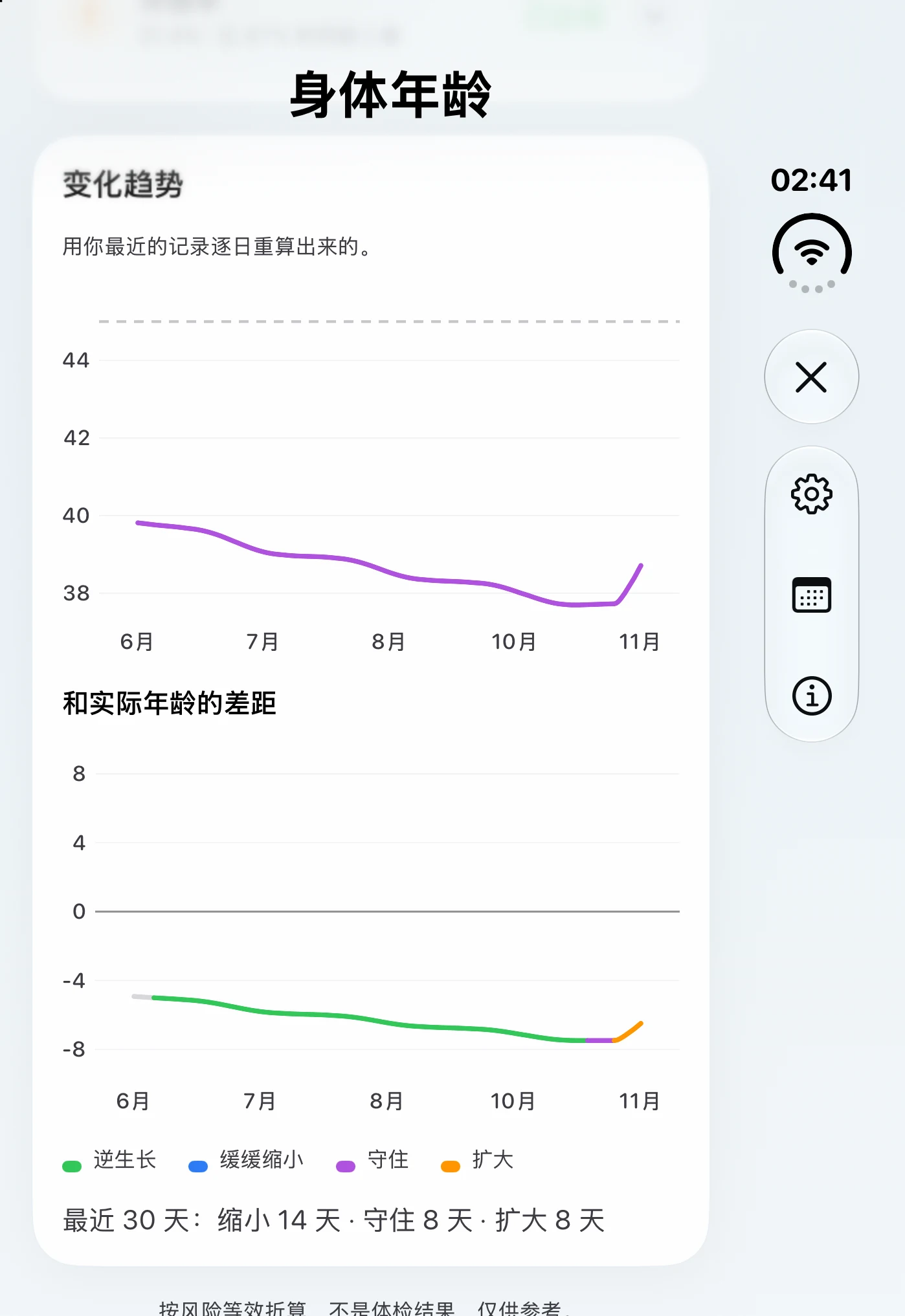
Sedentary people see the gap — which factor costs the most, and where to start.
Disciplined people see the payoff — multiple "−" rows, plus "on target" and "held for N days", positive signals beyond the years themselves.
Because health isn't only about improving. Holding steady is an achievement too.
The point of it all
Body Age isn't a number meant to make you anxious. It's a coordinate you can manage: where you are, where you're short, and which way you're heading.
It never claims medical precision, and it never pretends to be a checkup. It does one thing — turns the signals scattered across your sleep, steps and heart rate into a conclusion you can understand, and add up yourself.
The number will change. The direction is what matters.
Continuar a ler
Experimente estas ideias no Stress HRV
Descarregar na App StoreEstas notas partilham pensamento de produto sobre bem-estar. Não são aconselhamento médico.